
What "professional" should actually mean
Anyone with a van, a phone and a social media page can call themselves a clearance company. "Professional" on a flyer means nothing on its own. What counts is what happens to your things after they leave the house, and whether you'd be left answerable if it went wrong.
A clearance company worth the name can show you a few things straight away:
- a waste collection permit in its own name, which you can check yourself
- a fixed price in writing before the job, even if it's a WhatsApp message
- insurance for the work, and a straight answer about what it covers
- a plan for the contents: what's reused, what's recycled and where the rest goes
- a business name and contact details you can find again afterwards
This guide explains why those matter, starting with the part most people don't know: as the householder, you have a legal duty for your own waste. It's general information in plain terms, not legal advice. For the service itself, see our house clearance page or, in the city and county, house clearance in Dublin.
Your duty of care for the waste you produce
Irish waste law treats whoever produces or holds waste as responsible for what happens to it. When you clear a house, the old sofa, the bags of clothes and the broken fridge are your waste until they're handed to someone authorised to take them. The main law is the Waste Management Act, and each local council makes its own bye-laws on how households must dispose of their waste.
In practice, a householder should:
- hand waste only to an authorised collector, meaning someone with a valid waste collection permit, or bring it to an authorised facility such as a council recycling centre
- not let it be dumped, burned or left on the street, even by someone acting for them
- be able to show how it was disposed of if the council asks, so keep the receipt, invoice or written quote
The first point is the one people miss. Paying someone to take your waste away doesn't end your responsibility if that person had no right to collect it. "A man with a van took it" isn't much of an answer when your belongings turn up in a ditch.
How dumped waste is traced back to a household
Councils investigate illegal dumping, and dumped household waste is surprisingly easy to trace. A bag from a house clearance is full of clues: addressed envelopes, bank statements, prescription labels, parcel stickers, photographs, old school copybooks. Enforcement officers go through dumped waste looking for exactly that.
Many councils also use cameras at known dumping spots, and members of the public report vans unloading in lanes and laybys. Once a name or address turns up, the council can follow it up with the household, and the householder may face a fine, a prosecution or the cost of the clean-up. Saying you paid cash to someone whose name you never got doesn't help much.
That's the real cost of a suspiciously low offer. Fridges, mattresses, electricals and mixed waste all cost money to dispose of legally. A price that doesn't cover that cost is often a price that depends on dumping.
 spotless.ie
Checking a permit on the NWCPO register
Waste collection permits in Ireland are issued through the National Waste Collection Permit Office (NWCPO), which Offaly County Council runs on behalf of every local authority, and they're listed on a public register. Checking one takes a couple of minutes:
- Ask for the permit number before you book. A legitimate company gives it straight away, and it's often on their website, quotes and van.
- Find the register on the NWCPO's website and search by permit number or company name.
- Check the holder's name. It will be the company's legal name, which can differ from the trading name on the van. If it does, ask why; there should be a simple explanation.
- Check the status. The permit should be current, not expired, surrendered or revoked.
- Make sure it matches the business you're dealing with, and isn't a number lifted from someone else's website.
If you look up our permit, NWCPO-25-13287-01, you'll find it held by Krystal Klean Express Limited, trading as Krystal Klean, the company that operates SPOTLESS.IE. We're also fully insured on every job.
Want a clearance done properly? Send photos of the rooms, the attic and any shed, with your area. You'll get a fixed price in writing, usually the same day, along with our permit number to check.
Red flags to watch for
| What you see or hear | Why it's a worry |
|---|---|
| No permit number, or "we don't need one" | Collecting household waste for payment requires a permit |
| A permit that doesn't match the name on the register | It may belong to someone else |
| Cash only, and nothing in writing | Nothing to show the council, and nothing to hold anyone to |
| "We'll take anything, any time, cheap" | Legal disposal costs money, and very low prices often skip it |
| No business name, only a mobile number | Hard to trace if something goes wrong |
| Vague answers about where things go | A genuine company knows where its loads end up |
| Being asked to leave bags out overnight | Waste left on the footpath can be treated as litter |
None of these proves anything on its own, but two or three together should make you stop and check. Our guide to getting rid of junk in Dublin covers the other legal options, and house clearance vs skip hire compares the two main routes for a big clear-out.
What doing it properly looks like from your side
When a clearance is done properly, you end up with a few simple things:
- a written fixed price, agreed before the job
- a crew that checks drawers and pockets and hands you anything personal
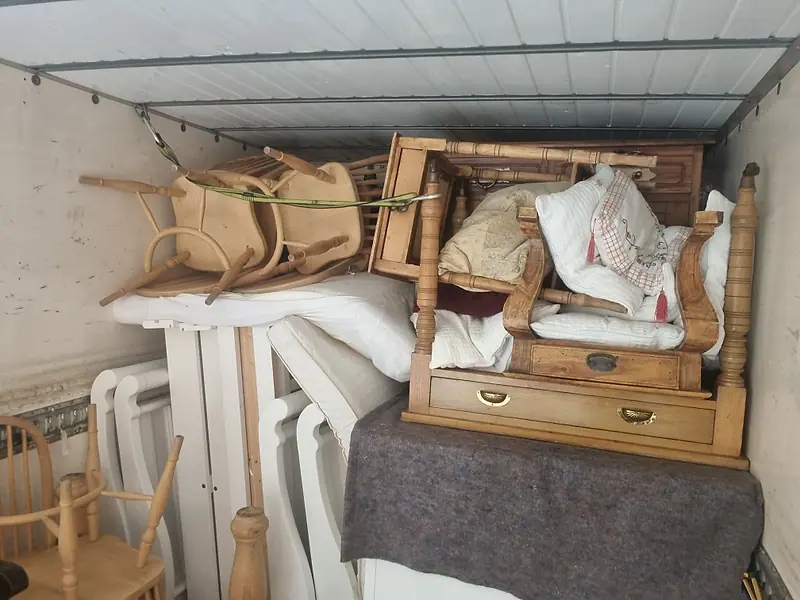
- the contents sorted, with reusable items set aside, metals, electricals and appliances recycled, and the rest taken to licensed facilities
- a receipt or invoice in the company's name, which is your proof of disposal
- photos of the empty rooms if you couldn't be there
To see where things end up once they leave the house, read what happens to furniture after a house clearance. If you're still choosing between companies, our guide to finding a house clearance company near you covers reviews, insurance and quotes.
Doing it yourself, legally
You don't have to use a company at all. You can bring waste to a council recycling centre yourself, ask your bin company whether it collects bulky items, or give usable furniture to someone who wants it. All of those meet your duty of care. It only becomes a risk when you hand your waste to someone without a permit.
For a full house, though, the trips add up fast, and so does the lifting. If it's a few bulky items or a room's worth, our junk removal service suits smaller loads. For a whole home, a clearance by a permitted crew does the lot in a day or two and leaves you with the paperwork to prove it.
