
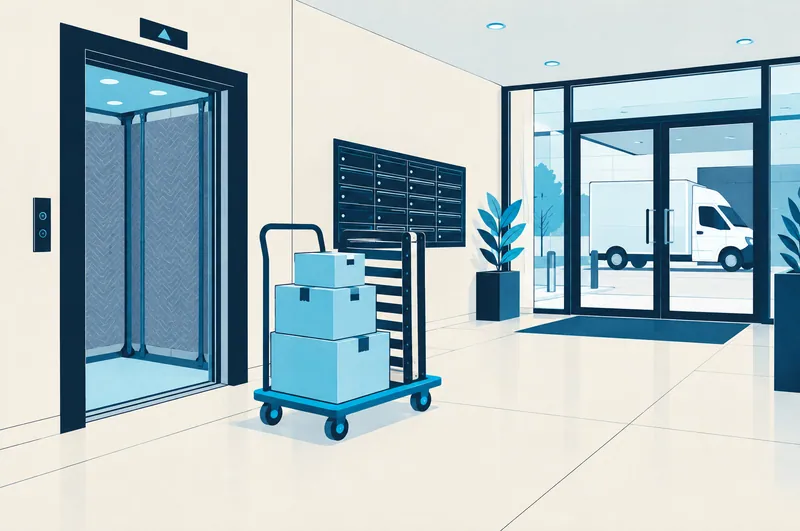
Start with the building, not the furniture
In a house, you decide when the clear-out happens. In an apartment block, the building has a say. You own your apartment, but the lobby, lifts, stairwells, corridors and car park are common areas, and in most Irish developments they belong to an owners' management company (OMC) that every owner is a member of. The OMC usually pays a managing agent to run things day to day, and the house rules it sets often cover how and when furniture can be moved.
Why do they care? Because a clear-out puts heavy, awkward loads through spaces every resident shares, and the OMC pays for any repairs out of the service charge. A scraped lift car or a gouged corridor wall costs everyone, so rules about moves are really about protecting shared property.
Contact the managing agent, caretaker or concierge at least a week before you plan to clear, and earlier for a big job. Ask:
- Which days and hours are allowed? Plenty of blocks restrict moves to weekday working hours, or ban them on Sundays and bank holidays.
- How is the lift reserved? Find out whether there's a booking sheet or app, and whether protective padding can be hung inside the car.
- Where should the van stop? Ask whether there's a dedicated bay, a drop-off spot by the entrance, or only on-street parking.
- Is there a height limit in the car park? Tall vans often can't get in.
- Is notice needed in writing? Some agents want an email with the date, the times and the company's name.
- What are the bin store rules? Usually nothing from a clear-out can go in the building's bins.
Write down the answers and the name of the person you spoke to. If anything goes wrong on the day, that's who you'll ring.
The lift: book it, measure it, protect it
The lift is the bottleneck of every apartment clear-out.
Book it. If the building has a booking system, use it, and book a longer slot than you think you'll need.
Measure it. Note the width, depth and height inside the lift, and the width of the doors. Compare them with your biggest pieces: the sofa, wardrobe, bed frame and fridge-freezer. Anything that won't fit has to come apart or go down the stairs.
Protect it. Many buildings keep padded lift covers. Ask for them to be hung before you start, and wrap the corners of tables and wardrobes in blankets.
Don't hog it. Stage things by the apartment door, then send full loads down in quick trips so neighbours aren't left waiting.
One firm rule: never wedge fire doors open, even for a minute. They're there for everyone's safety.
Loading bays, parking and the van
Parking is where apartment clear-outs most often go wrong. Think about:
- The van's height. Basement car parks usually have a height barrier at the entrance, and a box-body Luton sits well above it, so expect to load at ground level or in an open-air bay.
- Loading bay rules. Many have time limits or need booking through management.
- On-street parking. Walk out to the road a few days before and read every sign within sight of the entrance. Note the hours of any clearway or bus lane, whether bays are disc or permit only, and where the nearest legal stopping place is.
- Distance. The longer the walk from the lift to the van, the longer everything takes.
- Someone near the van. In a set-down area, it helps to have one person close by to move it if asked.
If you can reserve a visitor space or a loading slot, do. If you can't, find the nearest legal spot and keep the van there for as short a time as possible.

 spotless.ie
No lift? Walk-ups and stairs
Walk-up blocks, older buildings without lifts and flats over shops mean everything goes down by hand. That's fine, but plan for it:
- allow far more time than you would with a lift
- take furniture apart in the apartment so it clears banisters and tight turns
- clear landings and stairs of mats, plants and bikes first
- protect carpeted stairs, and walls at the corners
- never carry anything heavy down a stairwell alone
Converted period houses often have narrow, winding stairs. Measure the tightest turn before deciding whether a big piece will make it down in one piece.
Keys, fobs and access on the day
Small access problems lose more time than heavy lifting. Sort these the day before:
- a fob or code for the front door, the car park gate and the bin store
- a key for any storage cage or basement storeroom
- the caretaker's or concierge's phone number
- a note to neighbours on your corridor if the lift will be busy
- who gets the fobs and keys afterwards, if the apartment is being handed back
If you won't be there, decide who will let the crew in and lock up, and tell the building's management who to expect.
A simple one-week plan
| When | What to do |
|---|---|
| A week or more before | Contact the managing agent; ask about rules, lift booking and loading |
| A few days before | Book the lift and loading slot; confirm the times in writing; arrange fobs |
| Two days before | Empty and defrost the fridge-freezer; set aside or label anything staying |
| The day before | Tell the neighbours; check the parking; take apart anything you can |
| On the day | Lift covers on; loads staged at the door; fire doors kept closed |
| Afterwards | Walk through every room, return the fobs and photograph the empty flat |
Want the logistics handled for you? Send photos of each room on WhatsApp, with the floor number and a line about the lift and parking. We'll reply with a fixed price, usually the same day.
Tenants, landlords and what belongs to whom
Many apartment clear-outs happen at the end of a tenancy, so be clear about whose things are whose.
- Furnished lets. Check the inventory. The landlord's furniture usually stays unless they've said otherwise.
- Belongings left by a former tenant. Don't assume abandoned means yours to bin. A landlord has to follow the correct steps before getting rid of a departed tenant's goods, and the RTB (Residential Tenancies Board) publishes guidance on what those steps are, so read it before anything leaves.
- Handover condition. Rooms clear and floors swept is the minimum. Book any end-of-tenancy cleaning for after the clear-out, and if the carpets need attention, see our guide to end-of-tenancy carpet cleaning.
Landlords and agents turning a flat around between lets will find more in our guide to preparing a rental property and on our property clearance page.
Corners that get forgotten
Before you hand back the keys, check:
- the storage cage or room in the basement car park
- the balcony, including anything stacked against the railings
- the hot press and the tops of wardrobes
- the meter cupboard in the corridor, if things were stored there
- a bike left in the shared bike store
When it's worth getting help
If there's a lot of heavy furniture, no lift, tight time slots, or you simply can't be there, a crew used to apartment rules takes most of the stress away. Our apartment clearance service plans around the building's rules, protects lifts and corridors, and leaves the flat clear and swept.
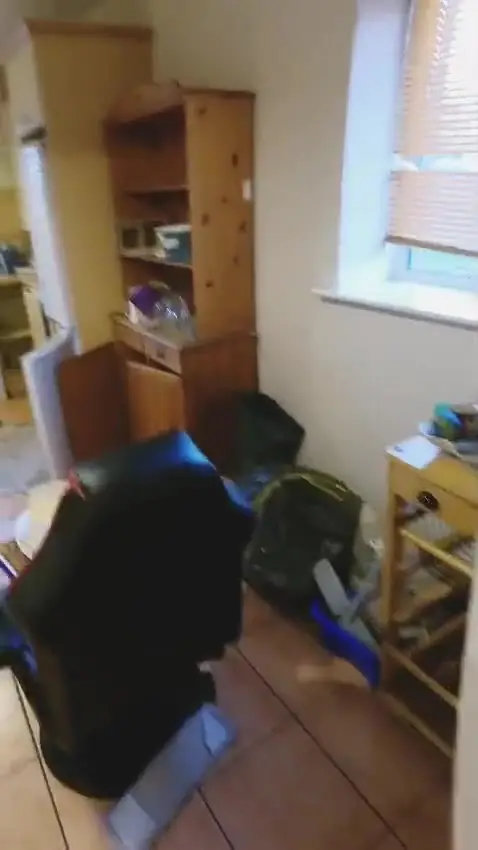
That short clip shows an apartment kitchen and living room after we cleared the contents.
For one or two big pieces, furniture removal may suit better, and when it's mostly bagged waste and odds and ends, junk removal is the simpler option. Clearing a loved one's flat? Our bereavement house clearance service lets the family set the timing and decide what's kept. To see where everything ends up, read what happens to furniture after a clearance.
