
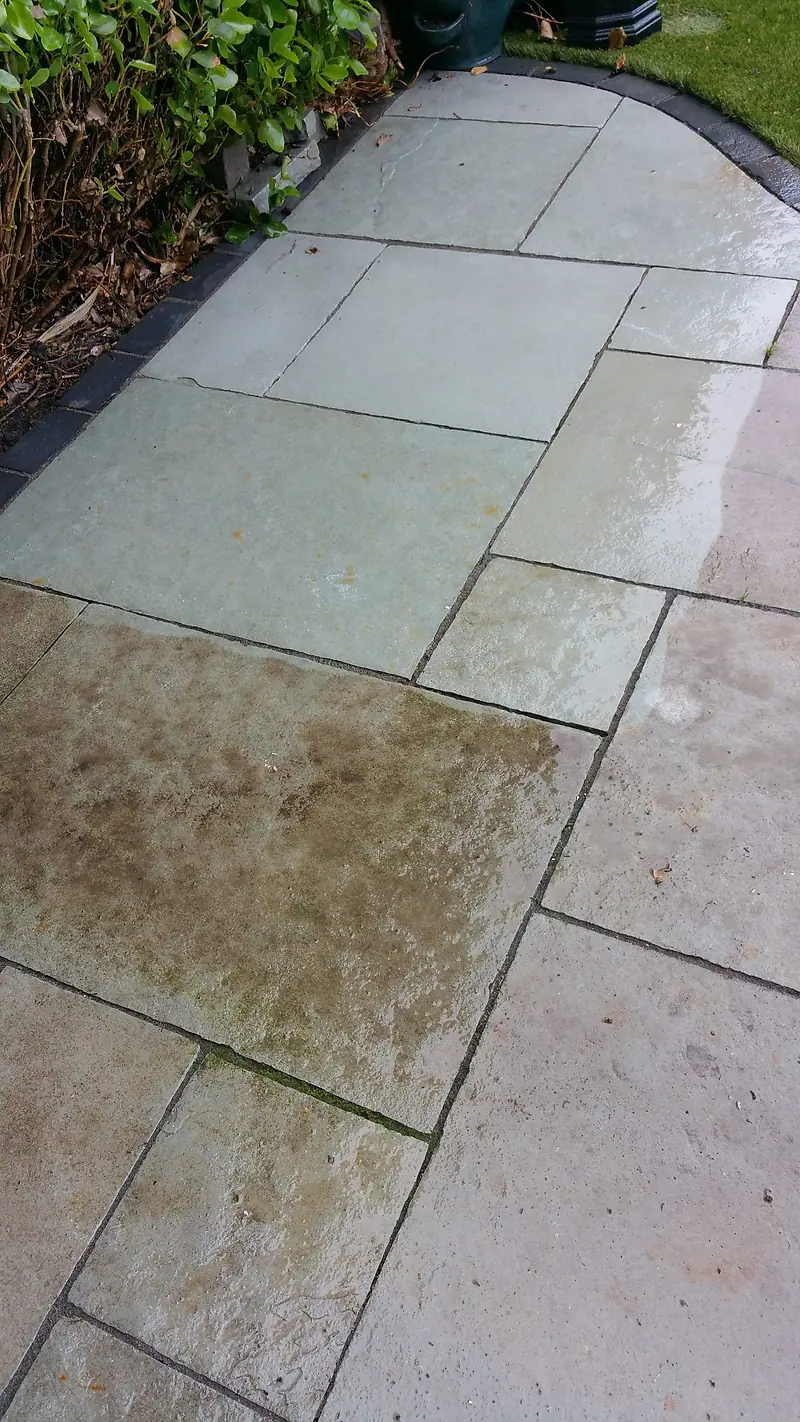
First, identify your stone
Most patios are made from one of a handful of materials, and each reacts differently to water, pressure and cleaning products.
| Material | How to recognise it | Main thing to watch |
|---|---|---|
| Indian sandstone | Layered, slightly uneven (riven) surface in mixed buffs, greys and browns | Soft and porous, so easily damaged by too much pressure |
| Limestone | Smoother and more even, often dark blue-grey or black | Etched by acidic products |
| Granite | Hard, with visible speckled crystals | Takes pressure well; the joints are the weak point |
| Porcelain | Thin, very even slabs, often printed to look like stone or wood | Doesn't absorb dirt, but slippery once algae builds up |
| Concrete slabs | Plain grey or coloured, sometimes with small stones showing | Porous, so stains soak in |
If you're not sure, a close-up photo in daylight usually settles it.
Cleaning each type
Indian sandstone
The most common patio stone in Irish gardens, and the easiest to damage. Sandstone is made of grains of sand cemented together in layers, and that cement is weak. A narrow jet held close to the slab breaks the grains loose, which is why a heavy-handed wash leaves the surface rough, striped and more open to dirt and algae than it was before.
The fix is to swap force for heat. Warm water softens the algae film, so the jet can sit further back, sweep in steady overlapping passes and never dwell on one spot. Expect freshly cleaned sandstone to show more variation between slabs than you remember, because the algae was hiding the natural colours.
Limestone
Limestone is denser than sandstone but sensitive in a different way: acids attack it. Acidic patio cleaners, brick cleaners and even vinegar can etch the surface and leave dull patches. Hot water at moderate pressure is the safe approach. Dark blue limestone, like the stone Kilkenny is known for, shows marks easily on a smooth finish, so take particular care with it.
Granite
Granite is hard and takes a hot-water pressure wash well. Rougher finishes hold dirt in their texture, and the joints are usually the weak point, so spray across them rather than into them.
Porcelain
Porcelain is fired at very high temperatures, so it has almost no pores for water or grime to soak into. The green you see is a surface layer, plus whatever has settled in the gaps between slabs, and warm water shifts the surface part with little effort. The gaps are where the time goes, and if the jointing is cracked or missing, cleaning won't fix it.
Concrete slabs
Tough but porous. They take a hot-water wash well, but old stains soak in and may lighten rather than vanish. Older slabs can be pitted, and the pits hold algae.
 spotless.ie
Black spot lichen: the honest version
Small black dots that don't come off however hard you scrub are almost always lichen, and they're especially common on sandstone. Lichen is a partnership between a fungus and algae, and it anchors itself into the pores of the stone. That's why it behaves so differently from moss and algae, which sit on the surface.
What that means in practice:
- Water alone won't reach it. The part you see is only the top of the lichen; the rest is lodged inside the stone, below where a jet can get without wearing the slab away.
- More force means more damage. Turning up the pressure erodes the sandstone around each spot long before the spot itself shifts, so you end up with pitted stone and the dots still there.
- Treatment is slow. A product made for lichen is applied and left to work, and the spots break down and weather away over weeks of rain, not in an afternoon.
- Fading is the realistic goal. Old, deep colonies often lighten to a faint grey rather than vanishing, and on a damp, shaded patio they return in time.
Anyone who promises to blast black spot off sandstone in an afternoon is going to either damage the stone or disappoint you. Send us a close-up and we'll tell you what's realistic for your patio.
Slippery patios
Algae turns into a slick, soapy layer the moment it gets wet, and it grows thickest in the spots that stay damp longest. On most patios those are the busiest spots too: the threshold of the back door, the treads of any steps and the paving under the table, where chairs and feet keep it from drying evenly. Shaded patios, and those beside a hedge or under a tree, are worst.
That makes the slip risk a reason to clean in its own right. For a household with an elderly parent, someone using a walking aid, or toddlers on the move, a patio that's green by the door is a fall waiting to happen, whatever it looks like.
Smooth porcelain and polished stone can be slippery when wet even without algae, so keeping the green film off them matters all the more. Sweeping off leaves, keeping water from pooling and letting light reach the slabs all help between cleans.
Is your patio looking green? Send a wide photo of the patio and a close-up of the slabs on WhatsApp, and mention any black spots. We'll come back with a fixed price, usually the same day.
Pointing and joints
Before any patio is cleaned, check the pointing between the slabs. Crumbling or cracked mortar can come out under a jet, and it's better to know that before than after. Weeds growing in the joints are a sign the pointing has failed or the joints were never fully filled.
Porcelain patios are often filled with a jointing compound rather than mortar. Once it cracks or washes out, weeds and algae move in quickly, and because the slabs themselves stay clean, the joints end up being the dirtiest part of the patio.
A clean can show up joints that need re-pointing, but re-pointing is a separate job. If yours needs it, have it done after the clean, once the slabs have dried out.
The best time of year
- Spring clears the green that builds up over winter, so the patio is ready for the first barbecue of the year.
- Late summer and early autumn get the slabs clean before leaf fall and the wet months set in.
- Avoid frost. A freshly washed patio can ice over, and any treatment needs a dry spell to work.
- Judge the result dry. Water darkens stone and exaggerates every difference in colour, so leave it until the slabs have dried right through before deciding how it's come up.
Keeping a patio clean
- Sweep off leaves before they rot and stain the stone.
- Keep water from pooling in low spots.
- Trim back hedges and branches that keep the paving in shadow from morning to evening.
- Lift plant pots now and then, or stand them on feet, to avoid rings.
- Use a drip tray under the barbecue, since grease soaks into porous stone.
- Put pads or feet under metal garden furniture, which can leave rust marks on pale stone.
- Check the gutters. An overflowing gutter dripping onto the patio keeps it permanently damp; see gutter cleaning, and roof cleaning if moss from the roof is the cause.
A shaded patio usually needs a clean every year or so to stay safe underfoot, while a sunny, open one can go longer.
Getting it done
Our patio cleaning service covers sandstone, limestone, granite, porcelain and concrete in Dublin and all of Leinster, with the method adjusted for each stone and hot water alone wherever it does the job. Granite steps and older stonework are covered under stone cleaning, rendered garden walls under soft washing, and timber decks under decking cleaning. If moss is the bigger problem, see moss and algae removal.
For the front of the house, it often makes sense to add driveway cleaning to the same visit. The driveway cleaning guide covers every type of paving, the power washing guide explains the methods, and our power washing page lists every surface we clean.
