

What your gutters are doing
Gutters have one job: catch the rain running off the roof and carry it to the downpipes, which take it down to the drains and away from the walls. Each run of gutter is fitted with a slight fall towards its outlet, so the water flows rather than sits.
When a gutter blocks, the water has nowhere to go but over the edge. And because the edge of the roof sits right above your walls, windows and doors, that's exactly where it lands.
Signs your gutters are blocked
The best time to check is during heavy rain. Stand back from the house for a minute and watch, and any trouble spot gives itself away with a sheet or a steady drip of water coming off the edge. A short phone video is useful if you're getting someone in to look at it.
Outside, look for:
- water pouring over the front of the gutter, or dripping from behind it
- weeds, grass or small plants growing along the gutter line
- a run of gutter that dips in the middle, or still has standing water a day after rain
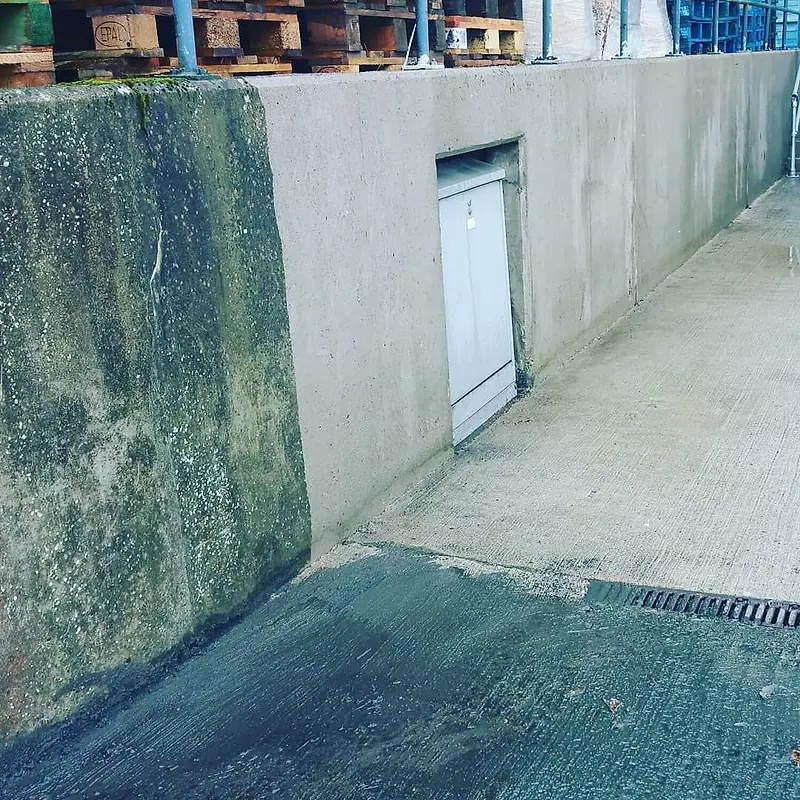
- green or dark streaks on the wall below
- soil washed away or paving stained at the base of the wall
- no water coming out at the bottom of the downpipe during a downpour, or a gurgling noise from inside it
Inside, look for:
- damp patches on walls or ceilings, often upstairs near the eaves
- paint or wallpaper bubbling at the top of an outside wall
- mould spots in the corners of upstairs rooms
Damp inside has plenty of possible causes, so a blocked gutter isn't the only suspect, but it's one of the easiest to rule out.
From overflow to damp: why it matters
An overflowing gutter looks like a minor annoyance. The trouble is that it happens every time it rains, in the same spot, all winter long:
- Walls get soaked. Water running down the same section of brick or render can soak into the wall, and the damp can find its way inside.
- Render stains and algae grows. Green and black streaks under a gutter are usually the result of years of overflow. Soft washing cleans them off, but they'll come back if the gutter isn't sorted.
- Timber rots. Painted timber fascias and window frames below a leaking gutter stay wet and start to decay.
- The base of the wall gets soaked. Water splashing down at the foot of the wall washes away soil and wets the bottom of the wall.
- Paths ice over. Water dripping onto a path or step in a frost creates a sheet of ice right outside the door.
Clearing a gutter is a small job. Fixing what years of overflow can do is not.
 spotless.ie
How often do gutters need clearing?
It depends mostly on what's above and around the house:
| Your house | How often |
|---|---|
| Open spot, no trees nearby, clean roof | Once a year, in late autumn |
| Trees close to the house | Twice a year, in late autumn and late spring |
| Mossy roof | At least once a year, and always after a roof clean |
| Gutter already overflowing | Now, before the next heavy rain |
Late autumn is the classic time, once the leaves are down and before the worst of the winter rain. Homes in mature, leafy estates fill fastest. Houses with no trees nearby still block. As concrete tiles age, their surface slowly breaks down into a sandy grit, and every shower rinses a little of it into the gutter along with any moss shed from the roof. If that's your situation, roof cleaning deals with the source, and our roof cleaning guide explains why moss grows in the first place.
Do gutter guards help?
Mesh and brush guards can keep leaves out, which helps under trees. They aren't a cure-all, though. Fine silt and moss fragments still get through or build up on top, and a blocked guard is more awkward to clear than an open gutter. If you have guards, they still need checking.
Doing it yourself safely
Clearing a bungalow's gutters from a ladder is a job plenty of people do themselves. If you're going to, take it seriously:
- Set the ladder on firm, level ground, never on soft soil or a wet slope, and have someone foot it.
- Don't lean the ladder against the gutter itself. Plastic gutters crack and bend; a ladder stand-off holds it clear of the gutter.
- Don't overreach. Keep your body between the sides of the ladder, and move the ladder rather than stretching.
- Stay off the top rungs, and never stand on a conservatory, porch roof or flat roof to reach.
- Look up before you start for overhead cables running to the house.
- Wear gloves. Gutter debris hides sharp edges, broken glass and bird droppings.
- Bag the debris rather than dropping it onto the paving or the flower beds.
- Pick a dry, calm day. Wind and wet rungs are a bad combination.
Two storeys or more, steep ground, a conservatory below, or anything you're not comfortable with: get someone in. Ground-based vacuum poles are one way to avoid ladder work, but compacted moss doesn't always come out with suction alone.
Would you rather stay on the ground? Send photos of the front and back of the house, and any spot you've seen overflowing, on WhatsApp. We'll reply with a fixed price, usually the same day.
Downpipes: the bit people forget
A clear gutter doesn't help if the downpipe is blocked, and downpipes tend to choke at predictable points. The outlet at the top is the narrowest part of the whole system, so debris jams there first. The offset bends, where the pipe kinks back under the eaves to reach the wall, catch anything that gets past the outlet. And the shoe at the base, where water drops into the gully, collects silt and leaves blown in at ground level.
Once the gutter is clear, run some water through it. If the downpipe gurgles, backs up, or water spills from its joints, there's a blockage. Blockages at the top and the bends usually clear with flushing. If water still won't go down, the problem may be in the underground drain, which is a job for a drainage company.
Fascias, soffits and the rest of the roofline
With the gutters cleared, the rest of the roofline often looks grubby by comparison: a green tinge on the fascia boards, dusty grey undersides and dark tide marks on the outside face of the gutter itself. Washing them at low pressure on the same visit means one set-up rather than two, and the whole roofline comes up together. Our fascia and soffit cleaning page explains how it's done, and why high pressure is the wrong tool on uPVC.
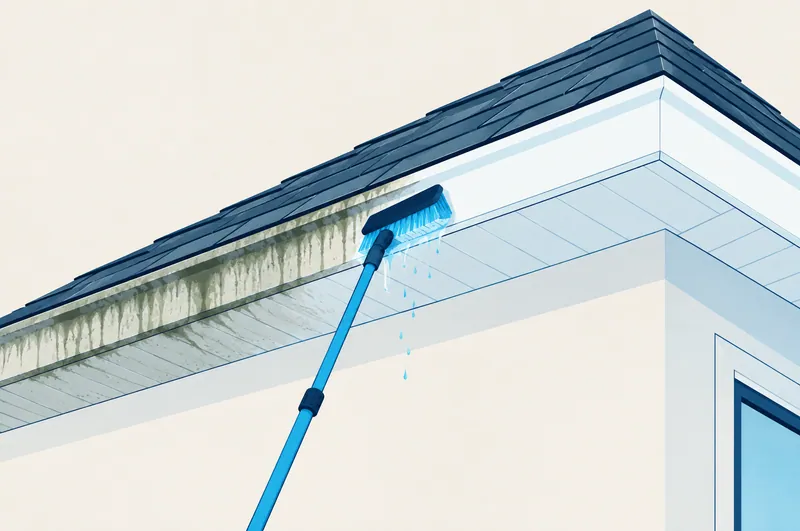
If the roof is mossy, start at the top and finish at ground level, gutters after the roof and paving after everything else. Clean in any other order and debris from one job lands on the one you've just finished.
When you're ready, our gutter cleaning service empties the gutters, checks the downpipes and takes the waste away, in Dublin and all of Leinster. If years of overflow have left the driveway or patio green underneath, it's worth adding those once the gutters are sorted, and moss and algae removal covers paths and walls. For everything else we clean, see power washing, and for how quotes are put together, how power washing is priced.
